
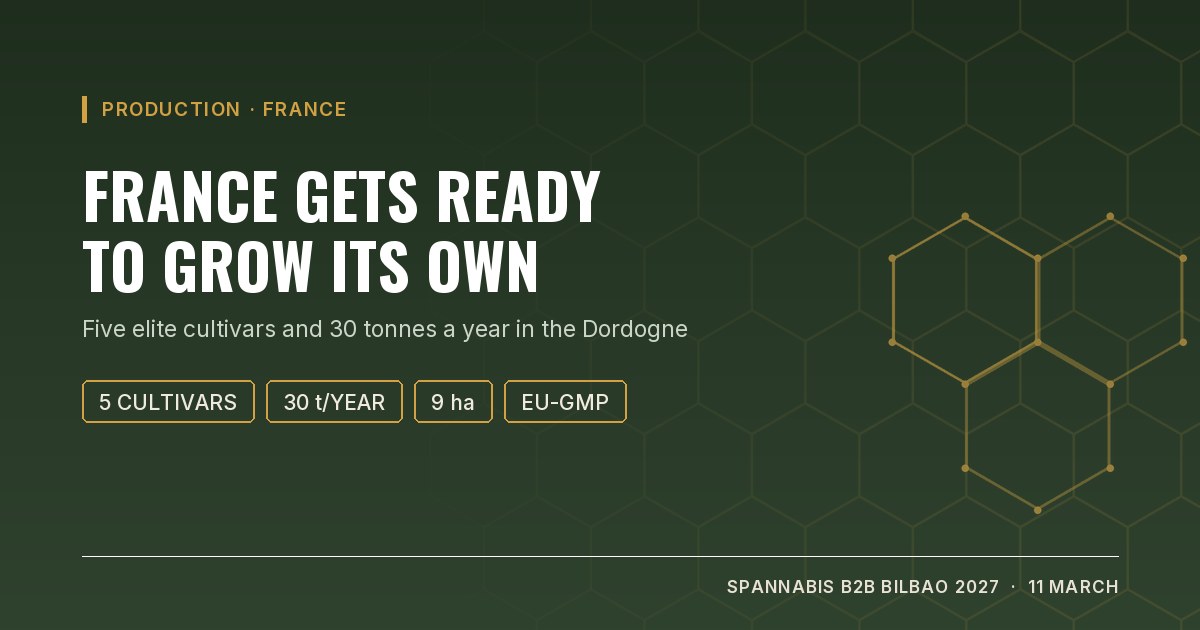
France has spent six years stuck in a pilot scheme. It is now building the infrastructure to leave it behind: French biotech firm PGP Farmer announced on 16 September that it has narrowed a 30-variety trial down to five elite cultivars, selected to supply domestic medical cannabis production once the country finally moves from experiment to standard law. The regulatory timetable, meanwhile, is working its way through the Conseil d’État.
What exactly was selected
This was not a choice made on paper. According to figures published by Business of Cannabis, the company assessed 2,400 seeds and transplanted 1,440 plants in a phenotyping trial run in the Netherlands, ending up with five genetics able to reproduce consistently under EU-GMP standards. Its medical director, Dr Frédéric Lota, summed up the criterion in one phrase: picking five elite varieties demanded “absolute rigour”.
There is a concrete industrial bet behind it. PGP Farmer raised €3 million in February 2026 and projects a capacity of 30 tonnes a year across 9 hectares in the Dordogne. For a market that does not formally exist yet, that is a position taken well in advance.
Where the French timetable actually stands
The French programme has run since 2021 as an experiment, with around 700 patients under the derogatory framework, extended to 31 December 2026. Moving to the ordinary system depends on several decrees. The one governing evaluation, reimbursement listing and pricing was sent to the Conseil d’État, and two further texts would let authorised companies step out of the R&D straitjacket and begin market authorisation procedures.
If the schedule holds, the final opinion from the Haute Autorité de Santé would land in October or November this year, with the first reimbursed prescriptions in 2027. Reimbursement will follow the standard French tiers: 65% for major therapeutic benefit, 30% for moderate, 10% for minor and 0% where medical value is deemed insufficient. The population potentially eligible under the pathologies already covered runs above 400,000 patients, against today’s 700. That gap in scale is the story.
Why it matters outside France
Roughly 75% of the medical cannabis consumed in the European Union comes from outside the bloc. Germany, the benchmark market, imported around 200 tonnes in 2025. If France launches its programme with domestic production already in place, two things shift at once: a large new buyer appears, and so does one more European producer competing for supply.
- A narrow import window. The first months of any national programme are covered by imported product. Whoever holds EU-GMP certification and a ready dossier gets in; everyone else watches.
- Genetics become a commercial asset. Selecting reproducible, documented cultivars is what separates a grow from a pharmaceutical supplier.
- Medium-term price pressure. More certified European capacity means less room for product imported from outside the bloc.
- The bottleneck is not agronomic. It is documentary: traceability, monographs, quality dossier and the ability to withstand audits.
What it means for Spanish operators
Spain has just covered similar ground with Royal Decree 903/2025 and its first standardised compounded formulas. France is a step behind on access and a step ahead on planned domestic production. For a Spanish company with export ambitions, the map that emerges is a European market where volumes are settled in regulatory offices years in advance, not in the growing season.
This is exactly the conversation that fills the agenda at Spannabis B2B Bilbao 2027, the International Cannabis Business Forum held on 11 March 2027 at the BEC VIP Hall. Producers, laboratories, distribution and investment in the same room, closing deals before the regulatory windows open. You can book your ticket or request a B2B table if you are negotiating supply, distribution or market entry.