
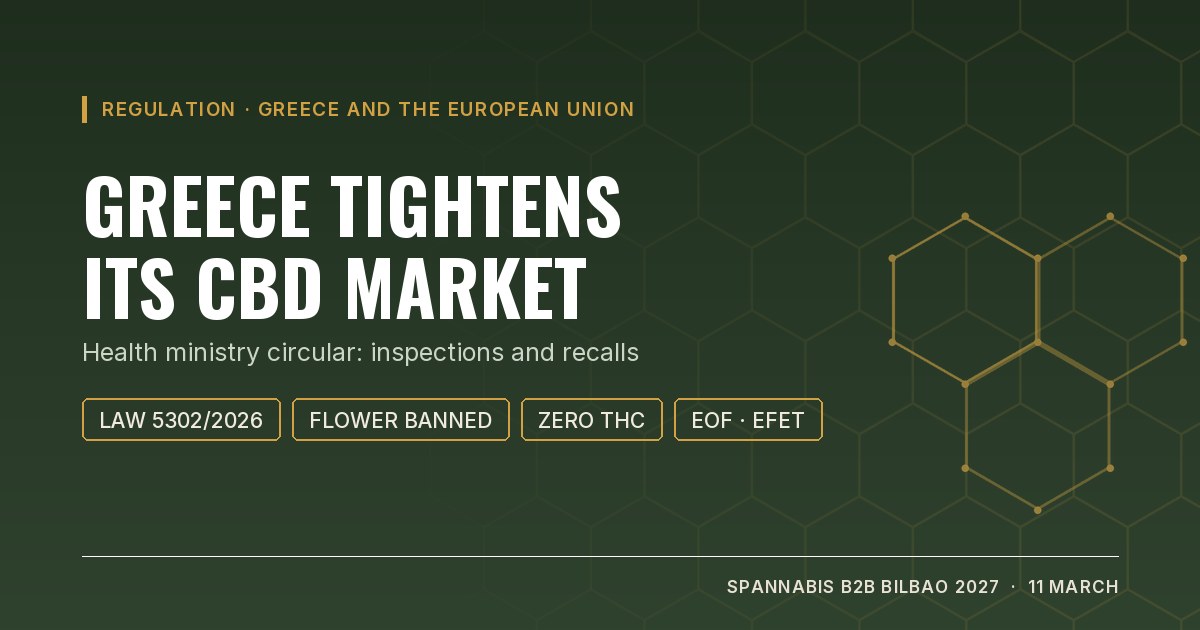
Greece’s Ministry of Health signed a circular on 15 September that spells out which cannabis and CBD products may be sold in the country and which may not. It is addressed to the regions, the police, the medicines regulator (EOF), the food authority (EFET) and the tax agency (AADE), and it orders inspections, laboratory testing and product withdrawals from both physical and online shops.
What the circular says
The circular implements Law 5302/2026, published in the Greek Government Gazette on 20 May, which amended the narcotics law (4139/2013) and removed dried hemp flower from retail sale even when its THC content is 0.3% or below. The ministry has chosen a restrictive reading: anything not listed as permitted is prohibited. According to the summary published by the specialist outlet Cibum, the banned list includes:
- Vapes and any product for inhaling or smoking that contains cannabinoids, whatever its THC content.
- Consumer sales of dried Cannabis sativa L. flower, including flower at or below 0.3% THC.
- Foods, food supplements and cosmetics containing THC at any concentration.
- Synthetic and semi-synthetic cannabinoids such as HHC.
On the permitted side are authorised medicines, CBD foods that comply with the Novel Food rules, seed derivatives (seeds, oil and flour) and supplements containing only CBD, with no THC, an EOF notification number and an analytical certificate. The text adds that label claims such as “legal”, “<0.2%”, “<0.3%” or “THC-free” do not make a prohibited product legal, and it sets HPLC and LC-MS/MS as the methods for detecting Δ9-THC and HHC.
The full-spectrum problem
The “CBD only” and “zero THC” requirement leaves full-spectrum and broad-spectrum extracts in limbo, since they retain other cannabinoids (CBG, CBC, CBN) and, in the full-spectrum case, traces of THC. That is the reading of Newsweed, which reports the complaint of KANNABIO, one of the Greek producers affected: its founder, Michalis Theodoropoulos, argues the measure sets the regulation of the legal market back fifteen years and encourages unfair competition. CBD isolate appears to fit, although traces of other cannabinoids could raise questions in testing.
A clash with the single market that was flagged early
The flower ban comes as no surprise. When the bill reached Parliament in May, Greece’s Economic and Social Committee (OKE) warned that it ran against the European trend and could conflict with the free movement of goods, as reported by Business of Cannabis. The law does keep import, storage and wholesale supply of flower intended for industrial processing into cosmetics, foods or supplements. In other words, Greece remains a possible destination for raw material, but finished products reaching consumers face a much narrower filter.
What it means for business
- CBD exporters to Greece: review formulations. A full-spectrum oil that sells without issue in other markets may be withdrawn there.
- Laboratories: more demand for testing with low detection limits for THC and HHC, and for certificates accompanying each batch.
- Distributors and online shops: distance selling is explicitly on the inspectors’ radar. A “<0.3% THC” label no longer works as a defence.
- Industrial flower suppliers: the B2B channel stays open, but the processing destination of each shipment should be well documented.
The Greek case adds to other restrictive moves in Europe, such as France’s ban on edible CBD, and confirms that the gap between what the EU allows and what each member state enforces remains the main regulatory risk for the hemp sector.
Where to discuss it
The regulatory fragmentation of CBD will be one of the underlying themes at Spannabis B2B Bilbao 2027, on 11 March in the VIP Hall at the BEC. If your company makes, tests or distributes extracts across several countries, this is the place to close deals with people already solving these problems. Get your ticket or book a B2B table for your meetings.