
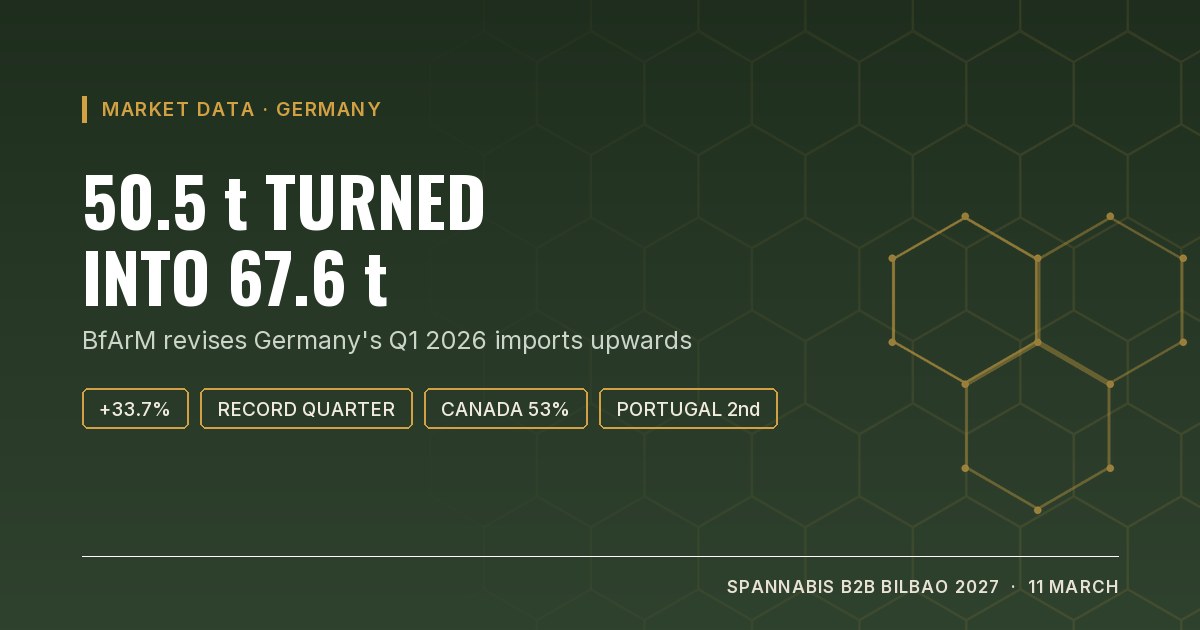
The number half the industry used to judge Germany’s start to 2026 was incomplete. In May the BfArM reported 50,539 kilos of cannabis flower imported between January and March. In August it revised that same figure to 67.6 tonnes, 33.7% higher. With the correction, the quarter everyone read as a slowdown becomes the largest the German regulator has ever recorded.
Why an official figure moves
The BfArM now attaches a plain-spoken note to its tables: the data reflect the situation at the time of publication, and import filings keep arriving afterwards. This is not a one-off. The second quarter of 2025 was revised up by 10.3%, the third by 4.4%, the fourth by 6.4%. A quarter’s first publication is a floor, never a ceiling, and the gap for this opening quarter has been the widest in the series.
For anyone buying, selling or financing in this market the practical consequence is blunt: the BfArM’s calendar does not match the calendar of commercial decisions. Three months and twenty percentage points can sit between the first figure and the final one.
The cooling narrative lasted three months
On the initial 50.5 t, the quarter was down roughly 15% against the close of 2025 and fed the thesis that the German market had peaked. On the revised 67.6 t, it sits 12.1% above the fourth quarter of 2025. That is the exact opposite reading, and it was published late and with far less noise than the first.
The annual frame puts it in scale: Germany imported 201,094 kilos of flower in 2025 against 72,706 in 2024, almost triple in twelve months. Against that baseline a record quarter is not a statistical anomaly, it is the trend continuing.
Who is actually supplying Germany
The country breakdown published in May, still based on the unrevised total, put Canada first with 26,753 kilos, 53% of the total. Portugal was second with 10,342 kilos and Denmark third with 3,338. The breakdown itself came with caveats: the itemised countries added up to 49,540 kilos and four origins were left unspecified.
Spain does not appear among the relevant suppliers. Portugal, with the same climate, the same peninsula and the same distance to Frankfurt, is the second exporter into Europe’s benchmark market. The difference is not logistics or agronomy: it is having built a cultivation and export licensing framework with EU-GMP certification first.
What to do with this
- Do not close supply contracts or build investor decks on the BfArM’s first quarterly release. Always ask for the cut-off date of the data.
- Work with rolling twelve-month windows rather than quarter-on-quarter comparisons, which is where revisions distort most.
- If the plan involves exporting to Germany, the entry ticket is still EU-GMP certification in manufacturing and GACP compliance in cultivation. Without them there is no pharmacy channel.
- For Spanish operators, Portugal is the nearest and most uncomfortable competitive benchmark: the market is there and the neighbour is serving it.
This is the kind of conversation we are taking to the BEC VIP Hall on 11 March 2027. Spannabis B2B Bilbao 2027 brings together producers, labs, distributors and investors to close deals with data on the table rather than headlines. Check the tickets and book your B2B table if your company wants a seat at the European supply negotiation.
Sources: Krautinvest and Hemp Gazette, on BfArM data.