
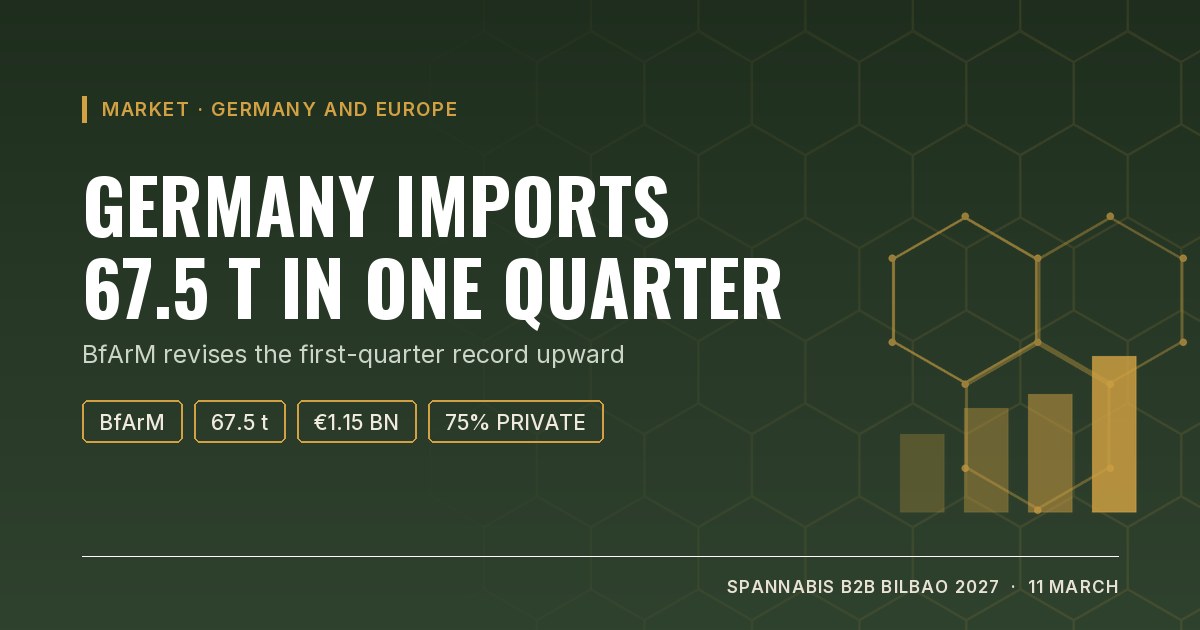
Germany’s federal institute for drugs and medical devices (BfArM) has revised its own figures upward: Germany imported 67.569 tonnes of medical cannabis in the first quarter of 2026, up from the 50.539 tonnes reported in May. That is 17 tonnes more than initially counted, and the largest quarterly volume ever recorded in Europe’s biggest legal market.
A record written twice
German statistics work like this: BfArM publishes a provisional quarterly figure and revises it as late declarations from importers and wholesalers arrive. The corrections are not marginal. Q4 2025 went from 56.625 to 60.772 tonnes, and Q3 from 56.915 to 59.076. Using pre-revision data, the International Cannabis Business Conference already counted more than 218 tonnes imported across four consecutive quarters; the Q1 adjustment pushes that rolling total above 235.
For anyone planning harvests, processing capacity or purchasing, the nuance is operational: the headline number underestimates real demand systematically, and whoever sizes production on the first release arrives late. Germany remains the world’s top destination for medical cannabis imports, with Canada as its leading supplier and a network of European processors — Portugal first among them — re-exporting into the German market.
The bulk of the business is already private
Volume only tells part of the story. The European Cannabis Insights 2026 report by Business of Cannabis and Prohibition Partners puts the German market at roughly €1.15 billion in 2026 and projects it will pass €1.5 billion within four years. The figure that reshapes any supplier’s commercial strategy: around 75 % of market value now comes from private self-pay prescriptions, and less than a quarter from statutory health insurance (GKV).
That imbalance sharpened in July 2026, when cannabis flower was removed from GKV coverage. Physician liability concerns had already been slowing the reimbursed route. Meanwhile, prescriptions grew by more than 3,000 % between March 2024 and December 2025, and the number of products available in pharmacies more than doubled.
More volume, thinner margins
The consequence of so much new supply is predictable: wholesale price compression. The report also flags a specific shortage — balanced strains meeting German pharmaceutical standards — coexisting with a general glut of flower. That is the difference between selling kilos and selling the product that is missing.
“The European cannabis industry has reached the point at which the winners will be decided less by regulatory outcomes than by the operational and structural choices operators make,” says Ben Stevens, editor at Business of Cannabis. Poland illustrates the other risk: after its telemedicine ban in November 2024, volumes fell 57 % before hybrid clinic models drove a recovery, with prices dropping from 65 to 47 PLN per gram.
What to watch from Spain
- EU-GMP and processing capacity: Europe’s bottleneck is not cultivation, it is processing and releasing batches to pharmaceutical standard.
- Differentiated product: balanced strains and scarce formats hold price; generic flower competes downward.
- Contracts with a regulatory clause: one rule change — telemedicine, reimbursement, mail order — can move a quarter’s volume.
- Self-pay as the real market: if three out of four euros come from the patient’s pocket, the commercial pitch targets clinics and pharmacies, not only the public system.
- Lagging data: planning on provisional BfArM figures means planning with about 25 % less market than actually exists.
This is exactly the conversation occupying European producers, importers and distributors right now, and the one we are bringing to the BEC VIP Room on 11 March 2027 at the International Cannabis Business Forum, Spannabis B2B Bilbao: who supplies Germany, at what margin and under which rules. Book your ticket or your B2B table and sit across from the buyers moving that volume.