
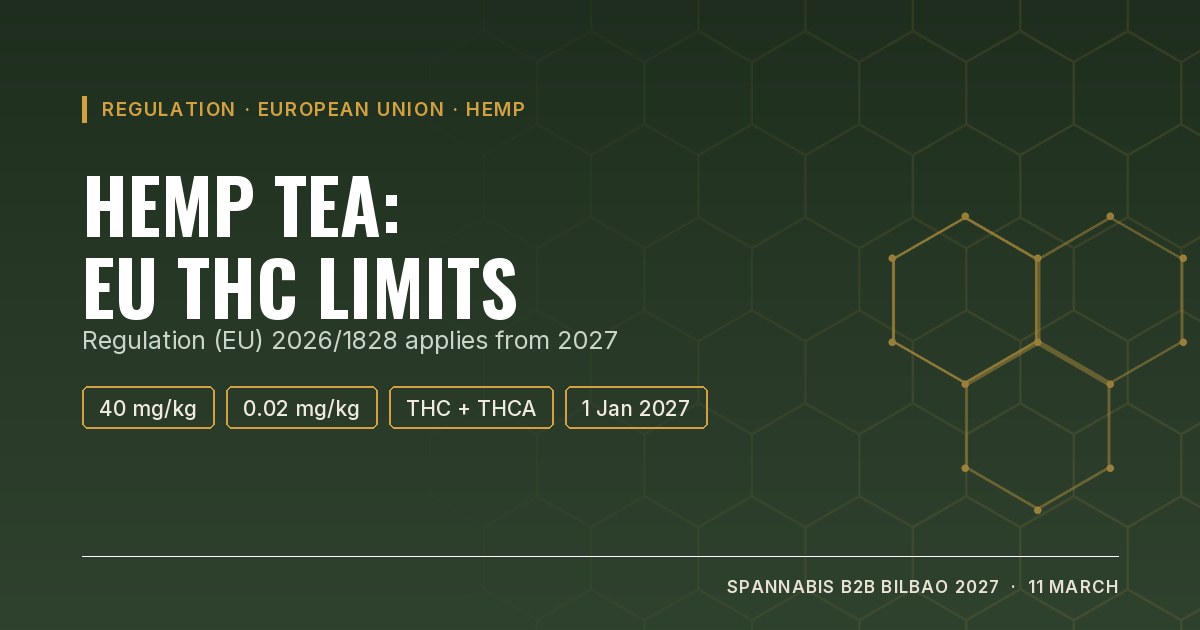
The European Commission has set maximum THC levels for hemp-leaf infusions for the first time. Regulation (EU) 2026/1828, adopted on 28 July and published in the Official Journal on the 29th, applies from 1 January 2027. That leaves three months to review batches, lab tests and labels.
What the regulation says
The rule amends Regulation (EU) 2023/915, the general framework for contaminants in food, and adds two new limits:
- Hemp leaves intended for infusion: 40 mg/kg of total THC.
- Ready-to-drink infusion made from those leaves: 0.02 mg/kg.
The calculation adds Δ9-THC and THCA together, expressed as Δ9-THC equivalents. That detail matters: a test that only measures neutral THC will no longer prove compliance. The scientific reference is EFSA’s acute reference dose of 1 microgram of Δ9-THC per kilo of body weight.
Mandatory labelling
Packs of leaves will have to state three things clearly: the product is only for preparing a water-based infusion, the drink should not be given to infants or young children, and fatty ingredients such as milk or cream should not be added while steeping. The last warning has a chemical basis: THC and THCA are fat-soluble, and fat sharply increases what passes from the leaf into the cup.
There is a reasonable transition period. Products lawfully placed on the market before 1 January 2027 may stay on sale until their best-before or use-by date.
Recognition with small print
The regulation confirms that hemp leaves, without flowering or fruiting tops, are a traditional food and do not need the novel food authorisation that is still blocking CBD. For the industry this is only half good news.
The European Industrial Hemp Association (EIHA) welcomes the recognition but considers the limits too restrictive. As reported by Hemp Today, the association had proposed 400 mg/kg for dried leaves and 0.08 mg/kg for hot beverages, and cites a 2023 German study in which the commercial teas tested averaged 221 mg/kg, more than five times the new cap.
The text also preserves stricter national rules. A tea that meets the 40 mg/kg limit is not guaranteed access to every Member State: country-by-country checks remain necessary.
What companies should do now
- Test current stock with methods that quantify THC and THCA together, in accredited labs, before producing for 2027.
- Review where the leaf comes from. Variety, harvest timing and separation from flowers drive the final content; grower contracts should set specifications.
- Redesign labels with the three warnings and plan stock rotation to sell through older inventory within the transition period.
- Map target markets with tougher national rules before signing distribution deals.
Beyond tea
The EU already had limits for hemp seeds and derived products in the same contaminants regulation. Adding the leaf confirms a trend: Brussels prefers to fit food hemp into general food law, with measurable figures, rather than leave it in a grey zone. For serious companies that means more predictability; for those living off untested products, the room is running out.
These rule changes, and how they affect the supply chain, will be on the table at Spannabis B2B Bilbao 2027, on 11 March in the BEC VIP Hall, two months after the regulation starts to apply. If you work with food hemp, get your ticket or book a B2B table to meet growers, labs and distributors.