
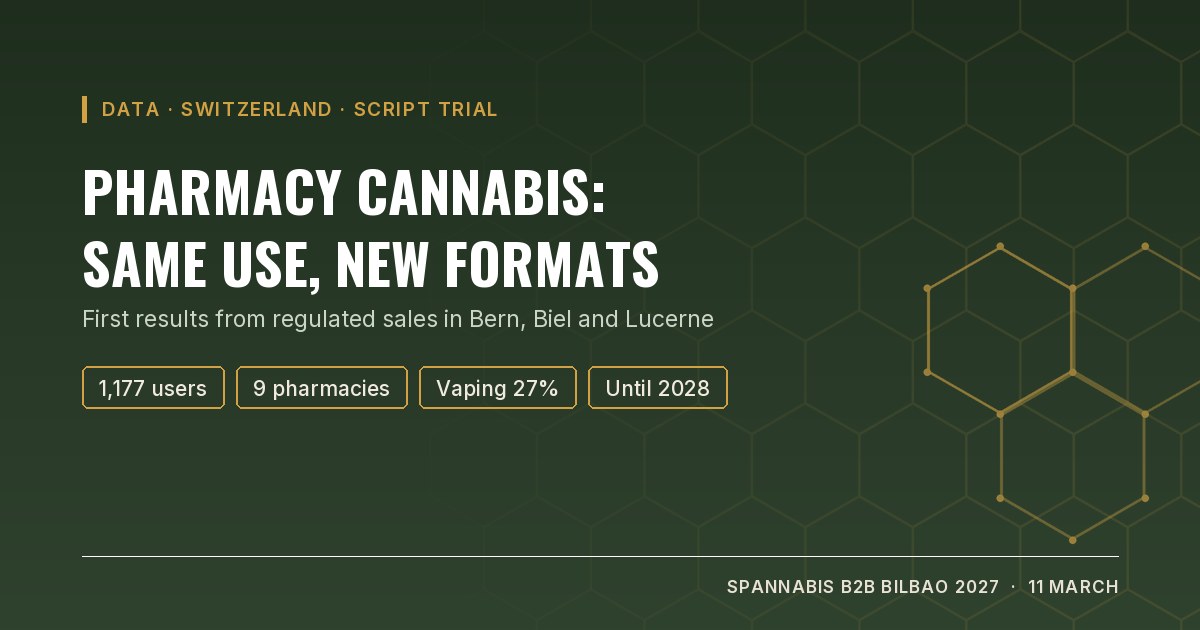
Selling cannabis through pharmacies does not make people use more, but it does change how they use it. That is the headline from the interim results of SCRIPT, the randomised trial run since 2024 by the universities of Bern and Lucerne in Bern, Biel and Lucerne. For anyone making or distributing product in Europe, the useful part is the data on sales, prices and formats.
How the trial works
SCRIPT recruited 1,177 adults who already used cannabis: 777 in Bern (five pharmacies), 261 in Lucerne (three) and 139 in Biel (one). They were randomly split into two groups: 588 got immediate pharmacy access and 589 waited six months as a control group. In all nine pharmacies, trained staff advise on lower-risk ways of consuming. The results were presented in Bern in early September, according to the University of Bern press release, and have not yet been peer reviewed.
Less smoke, more vaping and tinctures
Frequency of use barely changed over six months, with no meaningful difference between groups; researchers even point to a slight downward trend. What did shift was the format:
- Exclusive smoking fell from 78% to 58% in the pharmacy-access group.
- 27% of that group vaped, against 11% of the control group.
- 61% tried THC e-liquids and 24% tried tinctures.
The illicit market has not gone away: in the access group, 51% bought from study pharmacies and 40% still used illicit sources, mainly for flower, because of price and potency.
What sold and at what price
Over two years, the pharmacies sold 19,515 units of flower, 3,433 of resin, 6,363 of e-liquid and 814 of tinctures, according to the breakdown published by Business of Cannabis. Flower accounts for around 65% of units and e-liquids for 21%. Flower at 8% THC sold for CHF 10 per gram and at 18% THC for CHF 13, including a simulated tax of CHF 3 to 4 per gram (roughly 30% on the lower-potency flower). E-liquids and tinctures carried no such levy.
The trial also tested 127 illicit-market samples. Flower averaged 15% THC and resin 22%, peaking at 46%. Nine samples contained synthetic cannabinoids. Of 69 cases where participants estimated potency before testing, only one was right.
What it means for the industry
- Product portfolio: in a regulated channel with advice, non-flower formats gain share. E-liquids, tinctures and oils stop being an add-on.
- Price and tax: the price gap with the illicit market remains the main brake on flower. How each format is taxed shapes what sells.
- Quality control: unpredictable potency and synthetics in illicit product strengthen the case for traceability and lab testing.
- Timeline: pharmacy sales are authorised until 31 October 2028 and the study ends in late 2029. The range is set to expand with more strains, oil and, later, edibles.
Switzerland has eight pilot projects running, and its data adds to the results of the Dutch experiment. Together they form the evidence base for the next round of regulatory frameworks in Europe.
See you in Bilbao
Regulated sales channels, formats and quality are core issues for European producers, labs and distributors. Spannabis B2B Bilbao 2027 brings them together on 11 March in the VIP Hall at BEC. Get your ticket or book a B2B table to meet the companies building these markets.